Showing posts with label seedlings. Show all posts

Thursday, 24 March 2016

Seedling Update


I started a batch (batch?) of seedlings on March 5, so this is almost three weeks later.  Many of the tomatoes and peppers (the majority of the seeds) were successful but not all.  Although I have always found hot peppers to be the easiest to grow, I think the seeds I am using are just a bit old (2012).   Otherwise, most of what I planted are well on their way.


And, YAY, I managed to get a 72% successful germination on those pricey Xanthi peppers (8 seedlings from the 11 seeds).

Xanthi seedlings

Another batch of 72 peat pellets have been started.  The peppers are a second seeding due to poor results from the first seeding.  The broccoli, cauliflower and brussels sprouts are a regular indoor start and will be planted out later in May or June.  New this year for me is starting the kale (2 types), chard and kohlrabi from seed as these would normally be direct sowed.  I also have plenty of the same seed that I will direct sow as these indoor starts are just an experiment (the outdoor sowing has always worked fine).  I am just looking to get an earlier harvest.


Six pellets each of the following were started today:
  1. Jalapeno M Strain (the previous jalapenos haven't germinated well)
  2. Cowhorn hot peppers (same as jalapeno)
  3. Ancho peppers (same as jalapeno - what the heck, these weren't old seeds!) 
  4. Tiara cabbage
  5. Snow crown cauliflower
  6. Gypsy broccoli
  7. Jade brussels sprouts
  8. Di ciccio broccoli
  9. Nero di Toscano kale
  10. Kohlrabi
  11. Ruby red chard
  12. Scarlet kale
And more from the March 5th start includes this Italian lettuce leaf blend ... Sugar Ray decided to get into it a bit so it's a bit mangled on the right side.  I also have a similar container full of shallots that are doing quite well (not very photogenic tonight).


And how about those sweet potato slips?  These were placed into jars of water on March 6 so here they are at day 18 ...


This one in particular is doing well ... looks like a pretty bonsai tree.


We've had a last (I hope) kick of winter this week with about 4 inches of snow over the past several days (today was more about freezing rain).  But the coming Easter weekend shows some promising warm weather and I look forward to getting some work done outside!


Thursday, 26 March 2015

Seedling Progress

Well, things aren't looking too well on the pepper front.  But I do have some good progress with other plants, so maybe I'll start off with the good news.

After what seemed like forever, the parsley started to pop up a few days ago.  Looking good!


Likewise for the thyme (left) and sage. 


Tomatoes are ready to be transplanted. They are currently in peat pellets - this weekend I'll rip open the bottom of the pellet and just pop each one into individual pots with some good potting soil.


And I have some peppers that are doing OK ... these include Hungarian Hot Wax, one variety of jalapenos and a generic red pepper.


And that's where the good news ends.  What is left in my jiffy greenhouse (on a heat mat) is mostly different varieties of peppers, with maybe a few tomatoes here and there.  Although peppers can take a while to germinate, the fact that some are already looking like healthy seedlings would suggest that the rest are duds (some of these are from brand new seed packets!).  I will start with some fresh peat pellets and reseed this weekend as it's already getting a bit late to start peppers for my area.  I have honestly never had problems like this before, but hey, it's all a learning experience, right?


And I don't know what happened with my lettuce - old seeds, wrong temperature, inadequate moisture levels?  Lettuce is the easiest thing in the world to grow!  But this is all I have after 2 weeks:


And, arrggghh, the rosemary!  Two years ago was the first time I tried growing rosemary from seed.  Very shortly after that I decided never to do it again (see post growing herbs from seed ...not). But that was when I was under the mistaken impression that my rosemary would overwinter here.  Not so the case and I figured even with low germination rates that it's cheaper to grow from seed then to buy several plants each year. But oh ... so frustratingly difficult!  After scattering MANY seeds into this and two other 4-pack seed trays, I have a single sprout - can you see it in the upper right quadrant?  Ugh.  I'll reseed this weekend in the hopes of getting more than one plant out of an entire pack of seeds.  In the meantime, I need to baby this little guy as much as possible!


Tuesday, 1 April 2014

Seedling Update: April 1st - Mostly Tomatoes and Peppers


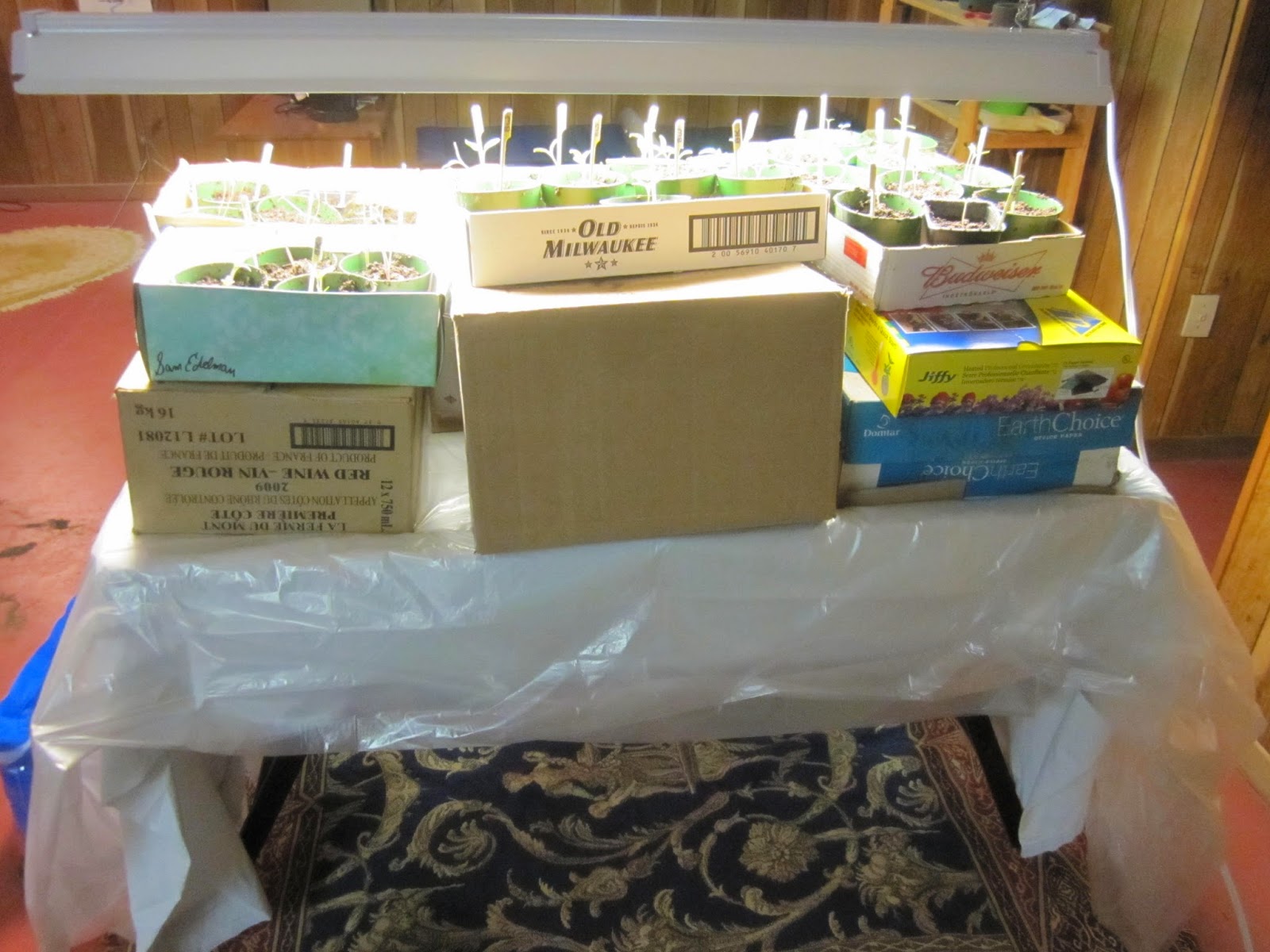
Hmm, I've cut back quite a bit on the number of seedlings I have already started, or plan to start, indoors this spring but only a month or so after planting the first seeds, I've already had to set up the second fluorescent light in the basement.  Even with the reduction from last year, I will still end up with at least a hundred or so.  And with each eventually transplanted into a 4" pot before going outside, you can imagine that takes a lot of space.


Speaking of 4" pots ... last year I had cleaned up a pile and left them in the basement as I knew I might not be able to get into the greenhouse until late March.  That was not enough so I thought I'd check out the now collapsed greenhouse and see if there was a way in to grab some gear.  No such luck.  Closest to the greenhouse where the snow has slid from the top, the snow is still 3 feet deep.  Luckily, after the windstorm did some damage to the greenhouse in the fall, I had pulled out some boxes of brand new 4" pots to store in the garage - I was hoping to barter with them this spring with another grower to save some cash, but I've had to use a stack of them.


This evening I transplanted another six each Brandywine and Black Krim tomato plants which has now doubled the totals for each.  And I did the same for about 20 San Marzano plum tomato plants.  I am having a hard time pinching away the weak ones; it always seems such a waste.  But I know what happens when 2 or 3 healthy plants compete for space and nutrients especially in these little pots.  So I'll have to do it soon.


A few days ago, I also seeded some asters and hollyhocks.  I'm already a few days behind last year on other flowers including cosmos, marigolds and nasturtiums, but that's just going to have to wait with the late winter weather we've been having.

But I did sow some watermelon seeds as those traditionally need a longer growing season that naturally occurs in these parts - and one has started to show today after only 4 days!


And lots of peppers on the heat mat (or some already under the fluorescent light) including several varieties of sweet red, two types of jalapenos, hungarian hot wax and some anchos (which I'm trying for the first time this year).

Wednesday, 26 March 2014

Okra Update (after 3rd day)


This morning's posting showed the okra seeds already sprouting after two days ... the picture was taken last night (Tuesday).  I just took another picture (Wed evening).  Unbelievable growth!  The seeds are large so I would expect them to germinate quickly, but wow!  The plants themselves (or at least the ones I've grown) don't get much larger than large pepper plants ... although after a quick viewing of "okra plants" in google images, I suspect I haven't been getting the full potential.

The other seedlings in the pic are tomatillos ... and the black krim tomatoes are starting to show.


Monday, 24 March 2014

New Seedlings, Jiffy Pellets and a Seed Schedule


Despite not having a greenhouse available this spring, I've gone ahead with starting some plants from seed already.  I suspect I am going to have problems in just a few weeks from now when many of them need to be transplanted into larger pots ... no idea where I'll put all of them at that point.

I have intentionally started less based on my experience last year (too many too soon).  But I still started quite a few ... and with winter never ending it seems, I'll still likely have some space issues to work out.  But I'll worry about that when it happens.

In the meantime, here is what I have started (the first batch is an update on a previous post):

A little over a month ago, I started some Brandwine and Black Krim heirloom tomatoes; these were from seeds I had saved from last year.  As it was the first time I have saved tomato seeds, I was anxious to see if I had been successful. No problem it seems; 5 weeks later and they are already about 4 inches tall.


I also started some sweet peppers - they take a really long time and are pretty tiny still.


The tomatoes and peppers started back in February are all under a fluorescent light set on a timer - on at 6am and off at midnight.  I bought this timer when I went away for a few days but it's pretty cool to have even when I'm home.  I don't have to worry about remembering anything!


And I have just started another big batch; mainly peppers and tomatoes again.  But a couple of other plants as well.

For these types of seeds (small seeds), I use the Jiffy "Greenhouse" setup with a heat mat.  The peat pellets have water poured over until the peat has expanded and has loosened up.  That's at least 2 litres of water for the 72 pellet setup I have. I generally use 2-3 seeds in each pellet to be sure something comes up.  If all three come up, I will wait until they are a couple of inches tall, then pinch away the weakest looking ones.


And to track all of this, I have started to document everything in a spreadsheet.  Here's a snapshot of what I plan to track (below).  I've already transplanted the first 4 types I started in February, but I can't recall the date so will leave it blank. But I'll be sure to track everything going forward.  This should really help to develop a routine over the next few years. I can adjust based on past experience and general weather conditions.

Hmm ... I wonder if I should also track other info like weather conditions?  I'll see as I go, I suppose.  I am also going to check around the internet and see what other people track on their seed schedule and take advantage of their experience to get on the right track sooner with my own plans.


Monday, 3 March 2014

Seed Planting Schedule


I find it very helpful to sort seeds into piles based on the time they will be planted - whether they will be planted indoors or outdoors.  I spent just an hour or so taking care of that this weekend.  I have the most seeds this year that I have ever had; I have saved quite a few of my own seeds from last year including varieties of tomatoes, pumpkin, squash and okra.  And I have also ordered more varieties of veggies, flowers or herbs than ever before.
 
There are two packets that I no longer need and I'll see if I can find someone who can use them: thyme and sage.  Perhaps I should wait until the snow is gone (will it ever go away?!) to make sure last year's plants have survived.  Assuming they are OK, I have plenty of each already.  And I'm just going to toss the packet of Russian Tarragon.  I ordered this thinking it was the right kind for culinary use only to discover it is tasteless (but a pretty herb plant and grows like crazy).  I managed to find a few French Tarragon plants at a plant sale and I hope they make it through the winter; they were a bit straggly even in the fall so I don't have high hopes.  But seeds for French Tarragon are hard to find and so, if necessary, I'll hunt down seedlings.

Herb garden in the fall

My seeds have been stored in separate containers for vegetables, herbs and flowers.  This helps when it comes time to order seeds.  But at this time of the year, that is no longer relevant.  The first step is to split them out into two piles: which seeds will be started indoors and which can be directly seeded into the soil.   The latter group is set aside and will be sorted through again much later.

The indoor seeding pile

The indoor pile is split out again by timelines.  For me, this is based on a combination of experience and the guidelines on the back of each packet.  The packets usually indicate the number of weeks before the last frost that seeds should be started indoors (so they can be transplanted into the soil at the right time).  I generally follow those guidelines other than adding a couple of weeks depending on my past experience.


Seeds are sorted into three piles:


1) Seeding indoor mid-March - here I've included all peppers (hot and sweet), tomatoes, tomatillos, okra, parsley (which takes forever to germinate), catnip (first time I'm growing from seed this year), pumpkin (in this climate I need as much of a head start as possible) as well as some flowers including hollyhock and asters (my asters took forever last year);

2) Seeding indoor early April -  Nasturtium and cucumbers;

3) Seeding mid to late April - summer squash (could easily be planted direct into the soil as they grow quickly but I like to stagger the start of a few); basil, cantaloupe and other melons and flowers including cosmos, delphinium (first time this year), marigold and Kong sunflowers.

The rest which are for direct seeding into the soil include beans, peas, beets, carrots, winter squash (which grow very quickly) as well as various greens (kale, lettuce) and the rest of the flowers.  Also there are brussels sprouts, broccoli and cabbage which will likely wait for a later planting for fall harvest.

For direct seeding outdoor

This is a very loose schedule; as I get closer to each deadline, I'll get a bit more detailed.  But this is a good start to getting myself organized for the coming season!  Being only my third year growing from seed, I welcome advice on my planned timing so please let me know if you do anything very different from this for the Eastern Ontario growing season.


Saturday, 1 March 2014

2013 Gardening Lessons Learned - Part 2: Germinating Seeds


In addition to good seeds and the right soil, germination requires a specific combination of water, light and warmth which changes for each type of plant.  Through the use of fluorescent lighting, I have that aspect covered.   

But I’m still working out the bugs on water and heat.
 
I almost always start seeds in jiffy peat pellets on a heat mat (2-3 seeds in each pellet to be sure something comes up!).  This seems to work very well so long as they aren't left there too long.  Once the seedlings have grown to an inch or so, they should be transplanted as these pellets dry out quickly.   I left mine a bit late and only transplanted them this morning.  Some had become quite dry even though I watered a bit each day - the peat dries out easily.


I also had a watering problem while using peat or coir fibre pots for the seedlings last year.  They do not retain moisture well and it seemed as though I was constantly watering.  One of the main benefits of using peat or coir fibre pots is the ability to plant the seedling into the ground, pot and all, which is very helpful for seedlings that are delicate and don’t transplant well.   


But the truth is I rarely did that last year; I removed the seedlings and placed them directly in the soil.  I think I’ll stick to plastic pots from now on.

Then I had the opposite watering problem with some other plants.  Last winter, I created a grow area (fluorescent lights, etc.) in the basement as that is where I had the most space.  In order to keep the basement warm enough, I had to use considerably more heat than I had been using as I have a wood stove in the upper living area as a primary heat source to cut back on heating costs.  But I was a bit cheap with the heating in March and, although almost everything germinated, I struggled with a few of the seedlings to keep them healthy … onions in particular which require a good amount of bottom heat during germination.  And the cooler-than-appropriate temperature was probably a factor in the green mold that grew on some of the potting soil; it’s bad enough to overwater, but to water too much in a cold environment makes it that much worse.  So the main lesson learned is to ensure the temperature is sufficiently warm wherever the seeds are germinating – pretty obvious huh?

Seedlings from March 2013

I ended up having a second grow area in the main living area (as seen in above photo).  This was due to the number of plants that I started indoors, but also that I started them so early in the year, they were quite large by the time I could move them outside requiring an enormous amount of space.  So another lesson learned: this year I have started off using the upstairs grow area and will only move to the basement if necessary.  I also plan to start fewer plants indoors than last year and to start them a bit later so I may not need the basement at all (lesson 3).  Especially since I won’t have the benefit of the greenhouse this spring (since it kind of collapsed from all the snow).

Black Krim seeds saved from 2013

But I still got a bit excited about the upcoming growing season and started some plants already - I don't know why I start tomato plants so early as they grow quite quickly.  I think it is because I wanted to test the seeds I saved last fall; obviously it worked as I now have a handful each of Black Krim and Brandywine tomato seedlings.  


Black Krim seedlings 2014


Peppers generally need an early start.  I've started a few each of some generic red peppers and Hungarian Hot Wax, and will start more in the next week or two.

Red Pepper seedling

So I have started some plants already but I haven't really gotten a schedule prepared.  When growing a wide variety of plants (vegetables, herbs, flowers) it really helps to have a timetable to follow whether the seeds are to be started indoors or seeded directly into the soil when it warms up.  That will be my next task ...

Monday, 8 April 2013

Yard and Plant Update - April 8th

Today is my last day of holidays, and my first two days back at work are in Toronto - leaving on the 6am flight Tuesday morning. I will be moving most of my plants from the solarium into a back room; although Sugar Ray has been really good about not getting into the plants (except on a couple of occasions), I just can't be sure how he'll react to that much time alone.  A friend is popping in Tuesday after work to check on him, but he will still have a full 24 hours on his own.  I'd rather take a chance on the plants being without sufficient sunlight for that time, than risk full destruction!

I have also decided to put two of my healthiest plants (one Hungarian Hot Wax pepper and one San Marzano tomato) out in the greenhouse for the two days to see how it goes. The nights are still going just below zero, but I am expecting the greenhouse to be a few degrees warmer, in which case, they should be fine (tomato is a bit wilted in this picture, it's just getting used to its new home in the grow bag).


And I'm still working on the raised garden setup in the greenhouse - it won't take more than a few minutes to get the rest of the logs needed, I've just been taking my time.  And I've moved some shelving around to make some floor space for tomatoes.  I never thought I would complain about having too many shelves and tables in the greenhouse, but there is actually very little floor space.  And tomatoes are much too heavy to sit on tables.  So I'm slowly reorganizing to make the necessary space.


While thinking of getting plants into the greenhouse, I checked my outdoor water spigots yesterday and discovered a problem (well, actually a friend helping me out discovered the problem).   There are two spigots, connected by the same main pipe. One of them has come apart at the joint, and needs to be soldered.  So I can't really use either of them, without water pouring out of the one open pipe end.


As a result, I figured I should take advantage of the slight flooding in my yard and collect some rainwater.  I pulled out one of my rain barrels and have been pouring buckets of water into it to be sure I have accessible water until such time that I can get the pipes fixed (not a big deal, but I'll need a day at home, and since I just finished a week of holidays, it might be a while!).


When dealing with the plant-cat-safety issue, I decided to put the tomatoes and peppers into the back room.  I think the greenhouse setup is safe enough to leave what's left (with a few chairs lodged up against it to make sure it can't tip over).


I gave all of the plants a good watering with 5-1-1 fish emulsion fertilizer, which I've been using once a week on plants that have been transplanted at least once into potting soil.  While watering, I did a count.  I counted only containers.  Against advice of much better gardeners than I am, I neglected to snip off the smaller plants in cases where more than one seedling came up.  I've always managed well enough to split them during the final transplant, so I'll just see how that goes this year.  So in some cases, I have many more plants than indicated by the container count.  This should be plenty for me, my friend for whom I'm supplying seedlings (see Black Walnut post), and still enough for a few giveaways to other gardener friends that might be in short supply.

San Marzano plum tomatoes: 39
Black Krim organic tomatoes: 27
Amish Paste plum tomatoes: 10
Jalapeno peppers (M strain): 15
Hungarian Hot Wax: 6 (plus a dozen seedlings still in the basement area)
Pick-a-pepper Sweet Pepper Mix: 7
North Star red pepper: 5
Other (Walmart purchase) red pepper: 10
Misc. peppers: 8 (labels got missed up, I'm guessing they are jalapeno)


The tomatoes/peppers are in the west facing guest room, with the greenhouse seen out the window.


The east facing master bedroom is also hosting a few items: the fig plants, rhubarb, raspberry and blueberry canes and some potatoes that are "chitting" (Russian Blue in the box and fingerlings in the bag).


Fingers crossed that everything is well when I return Wednesday evening ...