Showing posts with label grow vegetables. Show all posts

Tuesday, 15 March 2016

Well, I Guess I'm Growing Sweet Potatoes


This was absolutely an impulse decision.  Why can't I just make a garden plan and stick with it?!  These seem a bit fussy to me and I don't like fuss.  Like how I direct sow as much as I can (beans, carrots, chard) so I don't have to transplant.  On the other hand ... homegrown sweet potatoes!?  How awesome will that be?

Well, we'll see how it goes.  This is not exactly the climate for sweet potatoes.  Margaret at Homegrown - Adventures in my Garden is further south than I am and she gave them a whirl in 2015.  I was thinking even her area was too short of a season but not so as she had some success.

But I still had no plans.  And then I came across asterlanedibles at a seed exchange in Ottawa.  And she was selling sweet potatoes that she grew herself.  And she's even further North than me!  I couldn't help myself.


She said this area is fine for sweet potatoes but you need a short season variety and a very sunny area.  She sold me three sweet potatoes to start growing slips with.  They are Georgia Jet (or a shoot of Georgia Jet).


If they make it to the next stage, I will happily share an update.  In the meantime ... sigh ... I am sticking them in some water to grow the "slips" - which is just sweet-potato-fancy term for sending out shoots.

I watched a video showing someone planting actual sweet potatoes with slips "sprouting out of them" which seems no different to me than planting actual potatoes with "eyes that sprout".  So ... honestly and seriously ... just wondering if people make this seem difficult or what??

In the meantime, here they are at Day 9 with some roots (in the water) and some sprouts (above water).  Or are those "above water" sprouts the same size as when I bought them?

Love gardening.  Always.  Even when you don't know what is going on ... it's still super cool because, you know, earth and food and stuff.


Saturday, 13 December 2014

2014: My Year in the Vegetable Garden


With the amount of snow I already have, the 2014 gardening season seems so long ago!

I've only been growing vegetables for about a decade now and the first few years I was growing only the basics (for me that means tomatoes, potatoes and lettuce).  I am still learning so much every year and trying new techniques to figure out what works best.  And just when I thought I had at least a few things figured out, I moved - this was only the second season in this new location.  So the soil, moisture levels, weeds ... even the bugs are different though I am only an hour or two from where I used to garden (thank goodness I don't have wild parsnip to deal with here).

So here are some of the new things I tried this year, with some being more successful than others.

The 3 sisters garden.  Verdict: Total Failure.
I've grown plenty of squash before and have dabbled with beans.  But this is the first time I've tried to grow corn and the first time I put all three in the same plot.  None of them grew well so I can't comment on the benefits of growing them together.  I had intentionally planted this away from my other gardens simply because I was worried the corn would attract more pests (namely raccoons).  And I think I just put it in a spot that didn't get enough sun.  I only got a handful of beans, the corn never got past two feet tall and the red kuri squash plants were rather pathetic with no squash to show for my efforts.  Now that I've dug up this bit of my lawn, I'll find something else to put there that can manage with less sunlight.  But I do want to try corn again and might still try these three items together again next year.


Kale.  Verdict: Awesome.


I have never even eaten kale before this year!  I planted two types - Nero di Toscana (seeds from William Dam) and some seeds that I picked up at a seed swap when visiting my family in BC that turned out to be Red Russian Kale.  It is super easy to grow and required very little effort.  This is one of those "cut and come again" veggies - trim off the tops and it just keeps coming up.  And a very hardy plant - it is still standing up tall in my garden under all that snow!

Bamboo Poles for Peas/Beans.  Verdict: Useless.
But it wasn't entirely the fault of the poles.  In my ignorance, I somehow expected the plants to wind themselves around the poles so I didn't even give them so much as a nudge.  I had grown them up a trellis the previous year (my first year with either beans or peas) and they seemed to just take to it on their own. I kind of thought they'd do the same with the poles but ... no.  Anyway, I think I prefer the trellis concept simply because it is easier to manage in straight rows.  But I'm still working on exactly what those trellises will be made with next year.
  
Wood Ash in the Garden.  Verdict: Unclear.
I have a woodstove that I use throughout the winter.  I have geothermal heating and once the temperature drops below -25°C (which it does quite often around here), it simply isn't as effective in heating the house.  So I use the woodstove quite a bit which produces plenty of ash.  I keep the ash in a barrel near the garden and so I added some to the soil for the peas.  Ash is alkaline so I figured it would be good for peas.  Although the peas didn't magically work their way up the bamboo poles, I still had plenty of them.  I just can't say it was due to the ash.  But I'll do this again next year and also see what other veggies I can try it with.

Spaghetti Squash.  Verdict: Awesome.


This is the first time I grew spaghetti squash and also the first time I saved seeds from a store-bought veggie.  So I don't know the variety but they grew well and taste great.  But I think I'll purchase some seeds for next year just so I know what kind I'm growing.

Composting.  Verdict:  Total Success.
Okay, this is definitely not the first year that I composted.  But this is the first year that I successfully created useable compost in a single growing season.  I always had a good idea of mixing up browns and greens in the compost pile, but it took the spring seminar on composting to really teach me proper techniques - mostly I just wasn't turning it over enough.  I only had enough to cover a 10' x 10' space this year but I'm going to build a much larger compost area next year.

My Own Seed Potatoes.  Verdict:  Success.
This was more of a coincidence than anything intentional.  But when spring rolled around, I still had a lot of potatoes left from the previous year's harvest.  And they had started to sprout down in the cold room - I mean really sprout!  It's the first time I used my own potatoes to grow more potatoes.  I will definitely make that a plan again for 2015.

Harvest Mondays.  Verdict:  Super Fun!
This was the first year that I shared my gardening posts on Daphne's Dandelions Harvest Monday collection.  I had a lot of fun with it and have learned a lot from the many gardeners who also share their own successes and failures in the garden.

Next season will have plenty more firsts for me in the garden, I'm sure (one of them being kohlrabi as I tasted it for the first time this year and definitely want to grow some).  But I have plenty of time to check out other blogs and get my plans ready.  And I look forward to hearing about other gardener's new ideas for 2015!

Wednesday, 18 June 2014

Three Sisters Garden: The Planting


I love the concept of the Three Sisters Garden.  This is an ancient North American aboriginal gardening practice which is designed to improve yield and sustainability of crops.


The first sister is the corn ... she stands in the middle and provides support.  These are Golden Bantam Corn.  I planted the corn first; in a small circle near the middle of the space I prepared using a base of straw, followed by manure and compost then finally the soil.  The corn is now three weeks old.


The second sister is squash (in this case, Red Kuri squash).  Squash will grow over the area acting as a mulch and keeping the soil cool.   Two weeks after the corn was planted, when it was a few inches tall, I planted the squash seeds ... again, in a circle, about a foot out from the corn seeds.


Beans are the third sister.  She'll grow in and around the squash and up the corn while providing nutrients (nitrogen) into the soil to help the other two.  The beans were planted somewhere between the squash and the corn.  I used Scarlet Runner beans.


It is the perfect example of companion planting where each provides a benefit to another.

And I have added a fourth sister ... the sunflower.  This can also provide support to the beans if needed.

Unfortunately, it looks like the birds have gotten at the bean seeds.  It is possible they were pushed out of the ground during the recent heavy rains, but I also see beak holes in the soil which leads me to believe it was crows.  I see them around but they have never bothered the rest of the garden spaces.  Is it possible the little bit of corn growing is already putting off whatever it is that attracts birds??


I've replanted some beans but I was out of the Scarlet Runner so I used Tarbais.  Hopefully, some of the Scarlet Runner will survive and I'll have a combination of the two.

The garden is planted far away from my other gardening spaces as I was concerned about critters - raccoons mostly; though I have never actually seen or heard a raccoon around my property.  But the crows might be a problem so I'm glad it is on the other side of the yard.  It's a bit of an experiment as the space does not get quite as much sun so we'll just see how it goes.


Saturday, 7 June 2014

Brassicas: Enemy Mine


I have yet to figure out how to grow brassicas in the Eastern Ontario climate.  I suspect a lot of effort is involved and, until now, I have not been that dedicated (let's see how this year goes!).

My first effort was just a couple of years ago in the summer of 2012 when my attempt at growing brussels sprouts and cabbage was foiled by the hot, dry summer and thirsty/hungry deer that demolished many veggies that year (there were hoof prints inside the raised garden so I could easily identify the culprit).


Last year, again, the veggies (broccoli this time) succumbed to the heat and bolted; no time for heads to form.  I had started them indoors in early spring along with the tomatoes and peppers.  By the time they were supposed to mature, it was early July and 30+ degrees F and they were flowering already.


So rather than starting them in April as I did last year, I have just started them as seeds indoors.  But wow, they germinated quickly!  After only a few days, they are well on their way and I worry I've started them too early again.


I think I'll transplant them into 4" pots and just keep them in the house (which will be cooler than outside!) for as long as reasonable before putting them in the garden.  Here I have brussels sprouts, broccoli, cauliflower and savoy cabbage.

Any advice would be appreciated for the Eastern Ontario growing climate!!!!


Monday, 21 April 2014

Tomatoes in "Greenhouse" Garden (and General Tomato/Pepper Update)


Since the greenhouse will be torn down and replaced in the coming months, I know that I will have to take apart the raised garden that I built last year.  So as not to waste the dirt, I've moved it into pots and now have the first batch of tomatoes planted "outside".  Technically they are inside the greenhouse but most of the greenhouse area is now exposed to the elements after the collapse.


This first batch of tomatoes is about a foot tall and already flowering; these include both Black Krim and Red Brandywine that I germinated from seeds I saved last year.


The next batch of tomatoes (Black Krim, Brandywine as well as San Marzano) are well on their way and mostly in the natural light of the solarium.

 
The tomatillos were planted too early and are far too tall for the space I have:


The earliest batch of red peppers could probably be moved into pots in the greenhouse soon:


And the remaining peppers (2 types of jalapenos, ancho and several other sweet red varieties) are in natural light for the ones planted earlier and some are still under the fluorescent lighting:


Sunday, 6 April 2014

(Limited) Ranking of Seed Companies - Best to Worst


I've been ordering regularly from William Dam Seeds in Ontario for about 5 years but I decided to branch out a bit and order seeds from some other companies this year.  And there are some obvious factors to consider when ordering that I did not always think about this year - I was too excited about the selection!  So this is a good reminder for me next year and to anyone else who cares about the same criteria for ordering seeds.

I based my list on the following criteria, some of which are more important than others. 

I would be interested in what criteria other people use when ordering seeds and what are your favourite seed companies!?  I'm still new at this and there must be many out there that I have not even heard of!

CRITERIA:

- Selection of seeds: sufficient choices, different and new varieties?

- Do they sell organic versus treated seeds?  Some people care about this, some don't.  I do.  Unfortunately I wasn't paying attention when ordering from Stokes.

- Are they GMO free? I'm all for tomatoes that bruise less easily but not to the point that I want cells from fish to be genetically engineered into them.  Not cool.

- Do they have a link to Monsanto? Monsanto is crazy for genetically altering food products. Creepy, creepy, crazy. Lots of interesting articles available if you haven't heard about this yet.

- Price of Seeds: This is an obvious criteria.

- Cost of shipping: So is this.

- Comparable growing conditions?  Sometimes it's good to know that the seeds were grown and developed in the same growing region as mine so I can be equally successful. 

- Growing guidelines/packaging: I want the package to tell me best practices for growing.

- Any freebies: Freebies are nice.

I only ordered from 4 seed companies this year, so my ranking is very limited. Here it is ...

#1 and #2: I can't decide which is better, so they tie for my favourite:

  
West Coast Seeds and William Dam Seeds

All the seed companies I have ordered from have a huge catalogue and large selection of vegetable, herb and flower seeds.  Both of these companies also have some fun "mixed" packets which helps when you want a few varieties without having to buy multiple packets.


Shipping prices are about the same, but West Coast is a bit pricier for the seeds; likely because they are apparently 100% organic and GMO-free.  William Dam is also fully GMO-free (the most important) but not all of their seeds are organic.  However, neither company treats their seeds.  And both have signed the "safe seed pledge".

They are both located in Canada, but William Dam has an edge for me because they are in Ontario so share similar growing conditions versus the West Coast. And both packets provide detailed and easy to read growing instructions.


And finally, West Coast provided a bonus pack of wildflower seeds while William Dam sent a little booklet on "Germination Tips for Beginners".

#3: Park Seeds

This company is in the U.S.; based in South Carolina.  Lots of selection as with the others.  Their regular prices are definitely on the high side, but wow, they have AMAZING sales - my purchase from them was during a 20 for $20 sale.  In the case of the sales, you have a limited selection to choose from but plenty of options in my opinion.  There were plenty enough that I was interested in, so what a great deal! 


 And shipping was similar to West Coast and William Dam - about $7-8 for a regular sized order.


They have some organic, but identify as being fully GMO-free.  And they do acknowledge that some of their hybrid seeds are purchased from Seminis (a division of Monsanto).  So if you trust that they are being honest, you just need to be careful about your choices.

What I didn't like about them is their packaging: all of the seeds I ordered come in this dark brown packaging so I can barely read the print.  They do show guidelines on the back for seeding, transplanting, etc. but it is very difficult to read.  A nice bonus was included: a Gardeners Handbook with tips from initial germination right through to planning your garden plot.


#4: Stokes


Nope, not going to order from them again.  Although they are located in Canada, they don't actually develop all of their seeds locally.  The sunflowers are from the U.S. and the Hollyhock packet says the seeds are from China. 


And some of their seeds are treated ... I know the chemical treatments are intended to help reduce pests or diseases, but I am trying to grow organically and that doesn't work for me.


I do not recall seeing on their website any reference to Seminis or Monsanto, but I have seen other websites that suggest they purchase seed from them.  I can't be sure.

But either way, the chemical treatments and purchasing seeds from other countries has me a bit turned off.  So they come in last place for sure and I won't be ordering from them again.

Tuesday, 1 April 2014

Seedling Update: April 1st - Mostly Tomatoes and Peppers


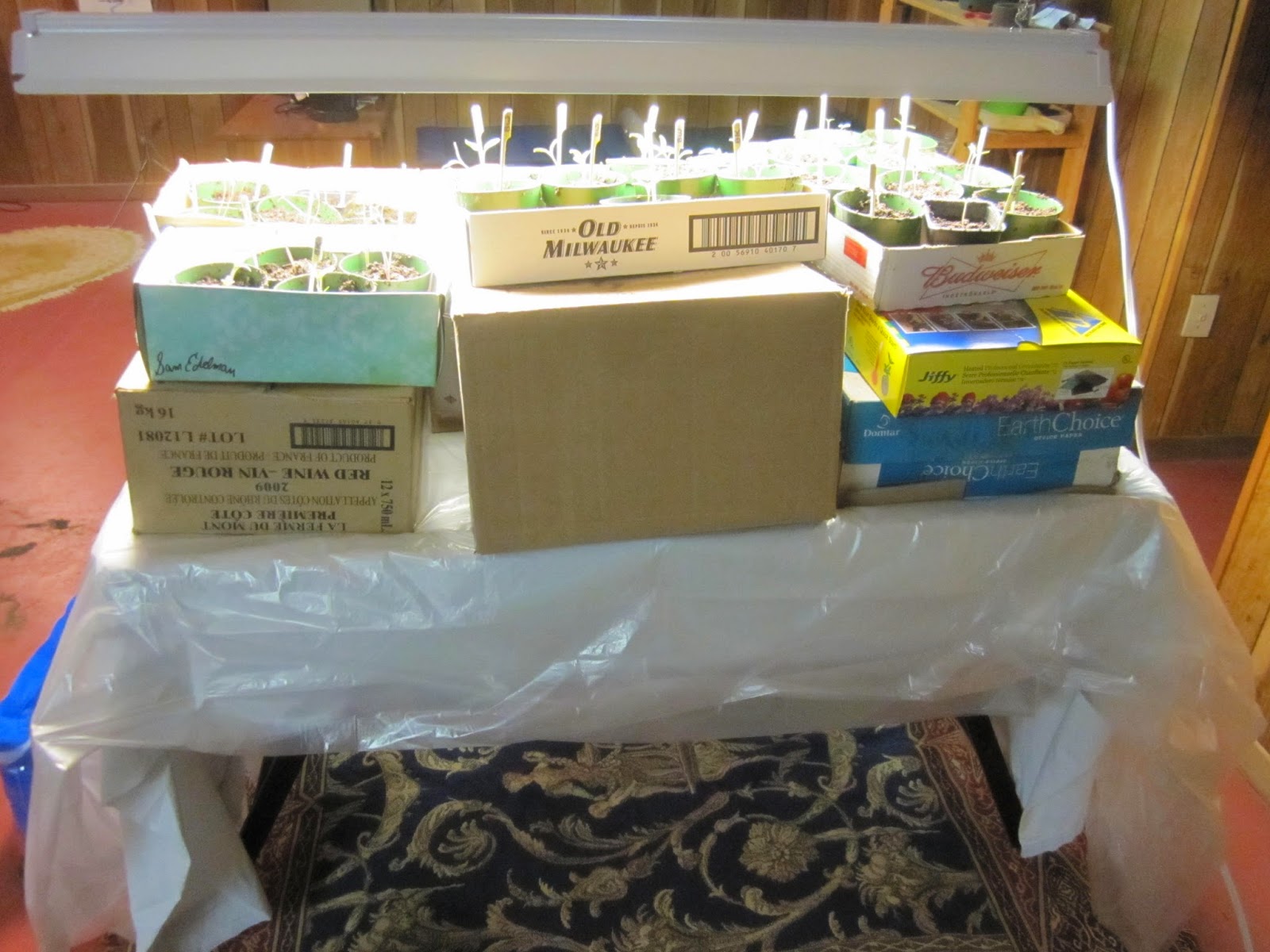
Hmm, I've cut back quite a bit on the number of seedlings I have already started, or plan to start, indoors this spring but only a month or so after planting the first seeds, I've already had to set up the second fluorescent light in the basement.  Even with the reduction from last year, I will still end up with at least a hundred or so.  And with each eventually transplanted into a 4" pot before going outside, you can imagine that takes a lot of space.


Speaking of 4" pots ... last year I had cleaned up a pile and left them in the basement as I knew I might not be able to get into the greenhouse until late March.  That was not enough so I thought I'd check out the now collapsed greenhouse and see if there was a way in to grab some gear.  No such luck.  Closest to the greenhouse where the snow has slid from the top, the snow is still 3 feet deep.  Luckily, after the windstorm did some damage to the greenhouse in the fall, I had pulled out some boxes of brand new 4" pots to store in the garage - I was hoping to barter with them this spring with another grower to save some cash, but I've had to use a stack of them.


This evening I transplanted another six each Brandywine and Black Krim tomato plants which has now doubled the totals for each.  And I did the same for about 20 San Marzano plum tomato plants.  I am having a hard time pinching away the weak ones; it always seems such a waste.  But I know what happens when 2 or 3 healthy plants compete for space and nutrients especially in these little pots.  So I'll have to do it soon.


A few days ago, I also seeded some asters and hollyhocks.  I'm already a few days behind last year on other flowers including cosmos, marigolds and nasturtiums, but that's just going to have to wait with the late winter weather we've been having.

But I did sow some watermelon seeds as those traditionally need a longer growing season that naturally occurs in these parts - and one has started to show today after only 4 days!


And lots of peppers on the heat mat (or some already under the fluorescent light) including several varieties of sweet red, two types of jalapenos, hungarian hot wax and some anchos (which I'm trying for the first time this year).

Thursday, 13 February 2014

Partial Seed Order 2014: West Coast Seeds and Stokes


As seen in this main photo, I have dozens of seed packets leftover from last year.  Some will more than suffice for this year's requirement of whatever type they are, but many packets are nearly empty and some I just didn't like.  Needless to say, I've spent another whack of money on more seeds for this year.

I usually order from William Dam Seeds.  Their seeds are untreated which is important to me (as I am trying to be as organic as possible).  They also have low shipping rates, low prices overall, and a large selection including some organic varieties.  So the bulk of my seed order this year is from William Dam (which I'll list in a separate post).  Oh, and they have awesome customer service!

But there were some interesting items that I wanted to try from West Coast Seeds and Stokes.  Actually, one item that both seed companies had that I wanted was aspabroc ... kind of an asparagus-style broccoli.  But it was just too pricey for me, especially when I already struggle to grow regular broccoli.

This year was my first West Coast Seeds catalogue.  It's fabulous!  They are dedicated to organic growing and have a great selection.  Their prices are a bit higher and their shipping is considerably higher (although I suppose that might have just been the distance thing).  But as I indicated in my previous post on ordering seeds (lessons learned ... ordering seeds), I like to buy variety packs to mix things up a bit and they had a good selection of "collections" or "blends".  I was particularly interested in the Three Sisters Collection since I was thinking of doing a 3 sisters garden this year; this single packet contains Golden Bantam corn, scarlet runner beans and Red Kuri squash ... none of which I've tried before.  And the beet blend pack and multi-colour cauliflower also offer my garden a bit of variety. 

West Coast Seeds

Cauliflower: Multi-Colour Blend (0.3 g)         $4.99*
Peppers: Ancho (0.5 g)                                     $2.99
Beans Dry: Tarbais (50 g)                                $3.99
Corn: Three Sisters Collection (25 g)              $3.39
Beets: Beet Blend (5 g)                                    $4.99
Carrots: Jeanette organic (0.5 g)                      $2.99

Subtotal:  $23.34
Tax:          $ 4.69
Shipping: $12.76
TOTAL:  $40.79

* Seriously, when I am writing this the $'s all line up but it gets funky when posted.

I've had a Stokes catalogue in the past, but this is my first order.  I didn't pay enough attention and it turns out their seeds are treated.  I'll see how it goes this year, but unlikely that I'll order there again.  The only reason I ordered from Stokes at all was to get the Kong sunflower seeds - these are supposed to grow up to 12 feet tall!  I can't wait!!!  But kind of pricey, so I really need to learn how to save sunflower seeds this fall so I don't have to keep purchasing these (I bet there are lots of people who can give me advice on this when the time comes!).  I also purchased some tall African Marigold's which, according to the description, could get up to 5 feet tall.  Since I was getting those anyway, I added a few more items since the cost of shipping was the same either way.

Stokes Seeds

The order is all for “packets"; I can't be bothered to look up the weight or seed count.

Cabbage: Savoy Ace Improved                       $3.25
Pepper: Super Red Pimento                             $2.95
Hollyhock: Summer Carnival                          $1.95
Marigold: Garland Orange African Tall          $3.95
Helianthus: Kong (2 pkts)                                $5.00
Cosmos: Double Click Mix                             $2.50

Subtotal:  $19.60
Tax:          $ 3.55
Shipping: $ 7.75
TOTAL:  $30.90

So $70 between these two companies, and that hasn't even covered off the basics yet ... yikes!  But the vast majority of my seed purchases this year should cover off my next year's needs as well (especially when I learn to save more types of seeds like the tomato seeds I saved last fall).

Tuesday, 16 July 2013

Patty Pan Squash


This is my zucchini harvest for today; I had a similar one just a few days ago.  I have kept up with most of the zucchini, but the patty pans seem to be multiplying exponentially.  Some good friends (thank you!) have accepted bags full.  I always purchase a package of mixed summer squash seeds from William Dam Seeds each year, and there always seem to be 4 or 5 patty pan plants.  Each plant can easily supply dozens, if not a hundred, little squash in just a few weeks.


I pick them small, 1-3 inches in diameter, as they are much more tender at that stage.  Besides, can you imagine 80 large patty pan's from each plant to deal with?!  They are still edible, for sure, but at that size, I am more likely to stuff and bake them.

But I also discovered that I have a crookneck squash plant, which I've never had before, so I'm excited about those.  Otherwise, I have the usual yellow and green zucchini, plus 1 eight-ball squash plant (they only look like 8-balls if they are picked quite small ... otherwise they become slightly more oblong).


This evening, I made a simple dinner with sauteed patty pan's and a handful of borlotti beans served with a bit of aged cheddar.  Fresh and delicious.


Tuesday, 4 June 2013

Hay Bale Gardening


I decided to try hay bale (or straw bale) gardening for the same reasons I built raised gardens - partly for aesthetics, but mainly to avoid digging dirt!  Yes, they look kind of neat in the yard, but most important is that there is ZERO digging required.  So for anyone that doesn't have good soil to work with, this might be a good option.  But that doesn't mean these are zero effort (try getting the bits of hay off the interior of my Pontiac Vibe - not really designed for moving hay).


Place your bales in position; it is suggested to put them where you want them before you start watering, as once they get waterlogged they are almost immoveable (as with anything I write about here, I'm just a beginner - if you read this and think it's a good idea, I highly recommend you do some research; there were plenty of sites available to help me out). 


And it is apparently a good idea to plant them touching each other so that there is less exposed area on each as they dry out easily.  I placed mine about a foot or so apart as I wanted space for the plants to spread (my plan was to plant pumpkins).

The bales I used were $2 each, and approximately 3' x 2' x 1.5'.


The bales should be placed so that the twine is horizontally around the bale in order to hold it together; it will slowly disintegrate over the season (or sometimes two seasons) and can then be used as mulch.  Had I placed my bale with the twine horizontally I would have had them taller than wide.  So I just wrapped my own twine around the sides so I could set them the way I wanted.


Then I just watered them every day for about 10 days - this was during the hot spell in early May and they are meant to stay constantly moist during this initial prepping period (so that didn't quite happen as it should have); eventually they kind of rot on the inside and start composting themselves.  I was a bit loose with following the instructions; the various websites I researched went into a lot more explanation about what needed to be done, but that's pretty much all I did. 


When ready to plant, I spread the hay apart and pulled out some of the gooey insides to create a 6" inch hole, filled it with dirt and popped in my seedlings.


I ended up not planting pumpkins here, as I created a separate patch further back in the yard (so I could have placed them closer together and avoided dealing with all that grass coming up in between!).  Two of the bales each have 2 marketmore cucumbers and 1 summer squash (mystery pack) and the third bale has two summer squash.


They still look healthy after a couple of weeks!  Hay bales are supposed to require a lot more watering than other gardens, but I have not really noticed that yet since there has been a lot of rain.

The slats set up nearby are from a broken shelving unit in the greenhouse which should help to support the cucumbers when they start to vine.